

U Visa Denial Reasons and Your Options After a Decision
Table of contents
A USCIS denial notice can feel final, but the next step depends on what USCIS actually denied and why. U visa denial reasons usually involve unmet eligibility requirements, insufficient evidence, or inadmissibility that was not waived.
The notice matters more than a generic checklist. It identifies the form, the stated grounds, and the deadline, which helps determine whether the next step may be an I-918 appeal, a motion, or a new filing related to an I-192 denial.
What Are the Main U Visa Denial Reasons?
The main U visa denial reasons are failure to establish a required eligibility element, a missing or invalid certification, an evidentiary record that does not meet the burden of proof, and inadmissibility that USCIS has not waived.
USCIS reviews whether the petitioner was a victim of qualifying criminal activity, suffered substantial physical or mental abuse, has credible information, was helpful or is likely to be helpful, and meets the required connection to United States law. These are the core requirements for U visa eligibility, and USCIS evaluates the evidence submitted for each one.
- Missing eligibility evidence. The record may not establish the qualifying crime, direct and proximate harm, substantial abuse, reliable knowledge, helpfulness, or the required United States nexus.
- A certification problem. Under the regulation in effect on September 12, 2026, Form I-918, Supplement B must be signed by an authorized certifying official within the six months immediately before filing. The certifying agency, not the petitioner or attorney, decides whether to issue or correct it.
- An incomplete or inconsistent record. USCIS reviews the evidence as a whole. A contradiction does not automatically cause denial, but unexplained conflicts can keep the petitioner from meeting the burden of proof.
- An inadmissibility issue. If a ground of inadmissibility applies, the petitioner generally must request the appropriate waiver on Form I-192. Approval of that waiver is discretionary and is not guaranteed.
The federal regulation at 8 C.F.R. section 214.14 sets out the U nonimmigrant status requirements, the initial evidence, USCIS review, and the route for appealing a denied I-918. USCIS has discretion to weigh evidence, but that discretion is not a separate denial ground when every eligibility requirement has been established.
A Pending U Visa Case Is Not the Same as a Denial
A long wait does not by itself mean that USCIS denied the case. A petition may still be under review, may receive a bona fide determination, or may be approved for placement on the waiting list because the annual cap has been reached.
As of September 12, 2026, federal law limits U-1 status to 10,000 principal petitioners each fiscal year. Eligible petitioners who cannot receive U-1 status solely because of the cap are placed on a waiting list. USCIS grants deferred action or parole while they wait and may authorize employment in its discretion.
A bona fide determination is also not final approval of the I-918. It may support deferred action and employment authorization in USCIS discretion while the petition remains pending. The current USCIS page for U nonimmigrant status should be checked for live program information.
Family members do not receive status automatically because a principal petition is pending or approved. The rules for U visa derivative beneficiaries depend on the principal petitioner’s age, the qualifying relationship, admissibility, and a separate Supplement A petition.
What to Check in the USCIS Denial Notice
The denial notice is the starting point. Read it before choosing a remedy because an I-918 denial, an I-192 denial, and a decision on another filing do not carry the same review rights.
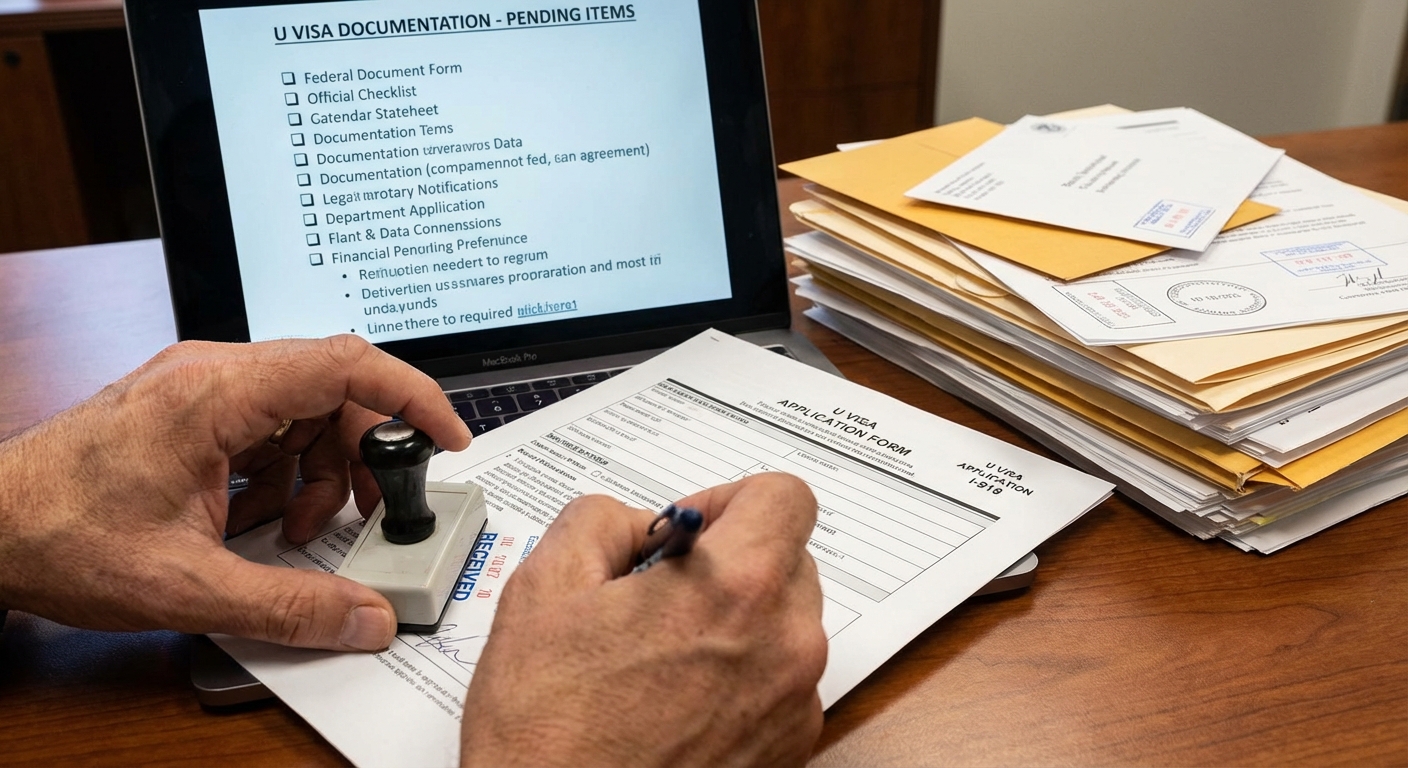
- Identify the form and decision. Confirm whether USCIS denied Form I-918, Form I-192, a derivative petition, or another request.
- Mark every stated reason. Separate eligibility findings, missing initial evidence, credibility or consistency concerns, and inadmissibility findings.
- Record the service date and deadline. Do not assume a standard period applies. The notice and the current form instructions control what may be filed and when.
- Check the review instructions. The notice should state whether an appeal or motion is available and where it must be filed.
- Review any removal case separately. A USCIS filing does not erase an immigration court order or stop ICE from acting on a final order.
Keep the notice, its envelope, and a complete copy of the filing. The mailing record can matter, and the original petition is necessary to compare USCIS’s findings with the evidence that was actually submitted.
Can You Appeal or File a Motion After a U Visa Denial?
Sometimes, but the available route depends on the decision. A denied Form I-918 may be appealed to the Administrative Appeals Office. A denied Form I-192 U waiver has no regulatory appeal, although a new filing may be possible when appropriate.
| Decision type | Possible next step | Important limit |
|---|---|---|
| Form I-918 denial | An appeal to the AAO may be available under 8 CFR 214.14 and the notice instructions. | Do not assume the route or deadline. Read the notice and current I-290B instructions. |
| Form I-192 denial | A new Form I-192 filing may be possible under the rules governing a waiver for U nonimmigrant status. | There is no appeal from the I-192 denial. An appropriate new filing is not barred, but approval is not assured. |
| Motion after a USCIS decision | A motion to reopen uses new facts and supporting evidence. A motion to reconsider identifies an incorrect application of law or policy on the existing record. | A motion is not a substitute for every appeal and does not automatically stay the decision. |
The rules for a motion to reopen or reconsider are different. Reopening requires new facts supported by affidavits or documentary evidence. Reconsideration relies on the existing record and explains why the decision applied law or policy incorrectly.
Different U visa denial reasons require different responses, so filing a new petition is not a universal solution. Before refiling, determine whether a new submission is legally available, whether the defect can be cured, and whether the certifying agency must act again.
Does a Petition or Motion Stop Removal?
No. Filing a U petition does not prevent ICE from executing a final order of removal, and filing a motion does not automatically stay a decision. A request to stay removal is a separate step with its own authority and standards.
The agencies also have different roles. USCIS decides the I-918 and I-192. The AAO reviews an eligible USCIS appeal. ICE may execute a final removal order, while immigration judges and the Board of Immigration Appeals operate within EOIR proceedings.
An I-918 appeal keeps that denial from becoming administratively final until the AAO affirms it, but this rule is not the same as a stay of removal. Anyone with a pending or final removal case needs advice that accounts for both tracks.
What to Do Next After a U Visa Denial
Act from the notice, not from a general assumption about U visa denial reasons. The most useful first steps preserve the record and keep a filing deadline from being lost while the decision is reviewed.
- Save the complete notice and envelope, then note the form, decision date, service method, and stated deadline.
- Compare each denial reason with the petition, personal statement, Supplement B, waiver request, and supporting evidence that USCIS received.
- Preserve new records without changing or recreating old evidence. A motion to reopen must identify genuinely new facts and support them.
- Ask the certifying agency about Supplement B only if the notice identifies a certification problem. The agency controls whether it will issue, correct, or sign a certification.
- Review inadmissibility and any removal order separately. A remedy for one part of the case may not resolve the other.
A U petition also does not guarantee status for relatives or permanent residence later. An approved petition is only one stage, and the U visa to green card process has separate statutory requirements.
If you received a denial notice, our U visa lawyer in Phoenix can review the form USCIS decided, the reasons it gave, and the deadlines printed on the notice before recommending a next step.
Frequently Asked Questions About U Visa Denials
What are the most common U visa denial reasons?
Common reasons include failure to prove an eligibility element, a missing or invalid Supplement B certification, insufficient or inconsistent evidence, and inadmissibility that was not waived. USCIS must explain the reasons in its written decision.
Can I appeal a denied Form I-918?
A petitioner may appeal a Form I-918 denial to the Administrative Appeals Office. The denial notice and current I-290B instructions control how and when to file, so do not assume the same deadline applies to every USCIS decision.
Can I appeal a denied Form I-192 in a U visa case?
No regulatory appeal is available from USCIS’s denial of the U waiver on Form I-192. The regulation does not prevent an appropriate new filing, but whether that step makes sense depends on the denial reasons and the available evidence.
How long do I have to file a motion after a U visa denial?
Use the deadline stated in the denial notice and verify it against the current form instructions. The available time can depend on the decision, service method, and requested review, so acting from a general deadline can put the case at risk.
Does a long U visa wait mean that USCIS denied my case?
No. A petition can remain pending, receive a bona fide determination, or be placed on the waiting list after USCIS finds it eligible but cannot grant U-1 status because of the annual cap. A denial is a separate written decision giving the reasons.
Sources and official resources
- 8 C.F.R. section 214.14
- USCIS pageOfficial source
- motion to reopen or reconsider
- USCIS: Immigration Options for VictimsOfficial source
- USCIS Policy ManualOfficial source

Jessica Anleu (formerly Jessica Lewis) is an experienced immigration lawyer in Phoenix with a decade of immigration experience.
All PostsRelated Posts
An immigration detainer and the 48 hour hold in Maricopa County
What an immigration detainer really means for a 48 hour hold in a Maricopa County jail, and the exact steps families should take before that window closes.
Preparing for your hearing at the Florence immigration court
The Florence immigration court operates inside one facility, but a nearby complex often gets confused with it. Here is how to tell them apart.

How the judge decides if you go home at an immigration bond hearing
An immigration bond hearing decides if you can leave detention while your case continues. Here is what the judge weighs before deciding your case.
Your privacy, your choice
With your permission, Google Analytics and Microsoft Clarity help us understand site use. Google Ads and Meta measure advertising. You can decline all or choose each category. Forms work with any choice.
Checked options stay off until you save them.