
U Visa derivative beneficiaries and how to include your family
Table of contents
8 minute read
Many U visa principal applicants wonder if their loved ones can also find protection, and USCIS indeed allows certain family members to be included, offering a pathway to safety and stability for the entire family. Understanding who qualifies as a u visa derivative is essential for ensuring your entire family unit can benefit from this protection, preventing family separation and fostering stability.
Navigating the specific requirements for family members, from relationship criteria to age limits and application forms, often presents significant challenges. Our U visa attorneys guide applicants through these complex steps to secure peace of mind for their loved ones.
Who can be a U visa derivative family member?
Identifying which family members qualify for protection alongside a U visa principal applicant depends directly on the principal’s age at the time of filing. The law establishes two distinct categories for a u visa derivative, based on whether the principal applicant is under 21 or 21 and older.
For principal U visa applicants who are under 21 years old, the range of eligible family members is broader, reflecting an understanding of the greater dependency often present with younger victims. This inclusion helps maintain family unity during a vulnerable time.
If the principal U-1 visa applicant is 21 years of age or older, the criteria for including family members in this U visa category narrow. The focus remains on immediate family, recognizing that adult principal applicants typically have a more established independent life, even while needing to protect their core family unit.
Eligible family members based on principal applicant’s age
The specific relationships that qualify for derivative status are clearly defined, and all children must be unmarried to qualify. This marital status requirement applies regardless of the principal applicant’s age and is a common point of confusion for many families we assist.
- Principal under 21: Your spouse, unmarried children under 21, parents, and unmarried siblings under 18 years old.
- Principal 21 or older: Your spouse and unmarried children under 21 years of age.
When a family member is themselves a victim of abuse by the principal applicant or by another qualifying relative, parallel paths such as a VAWA self-petition may also apply, depending on the relationship and the specific circumstances of the abuse.
What is an indirect victim for a U visa (and how is it different)?
The concept of a u visa indirect victim introduces a distinction from a standard u visa derivative beneficiary that significantly impacts their eligibility and application path. While derivatives gain status through the principal applicant without directly qualifying for the U visa themselves, indirect victims are recognized as direct victims in specific circumstances.
This path is generally available when a direct victim of a qualifying crime is unable to apply for the U visa personally. The intent is to extend protection to family members who have also suffered harm when the primary victim cannot pursue the benefit.
Understanding the indirect victim category
An individual can qualify as a u visa indirect victim if the direct victim of a qualifying crime was killed, incapacitated, or rendered incompetent. In these scenarios, the indirect victim essentially steps into the shoes of the direct victim to pursue the U visa.
Unlike a derivative beneficiary, an indirect victim must meet all primary U visa eligibility requirements themselves. This includes suffering substantial physical or mental abuse as a result of the qualifying criminal activity and demonstrating cooperation with law enforcement in the investigation or prosecution of the crime.
Derivatives, in contrast, are exempt from these specific requirements. Their eligibility flows directly from the principal’s approved petition, simplifying their path to protection.
For example, if a child is the direct victim of a severe crime and is killed, their parent could potentially qualify as an indirect victim. Similarly, if an adult direct victim becomes permanently incapacitated due to the crime, their spouse might apply as an indirect victim.
These situations highlight the distinct differences in how each family member category must establish their eligibility under U visa law. Understanding these distinctions is important to ensure the correct application pathway is chosen and followed.
How do you apply for U visa family members?
Once you confirm your family members meet the derivative eligibility criteria, the next step involves submitting the correct documentation to USCIS. The application process for this protection is designed to link directly to the principal applicant’s petition, ensuring all family members are considered as part of a single unit.
Accurate and complete filing is essential, as any errors can significantly delay the process or lead to denials. Many families find value in gathering all required documents and proofs of relationship before submitting their applications.
Submitting your petition for family members
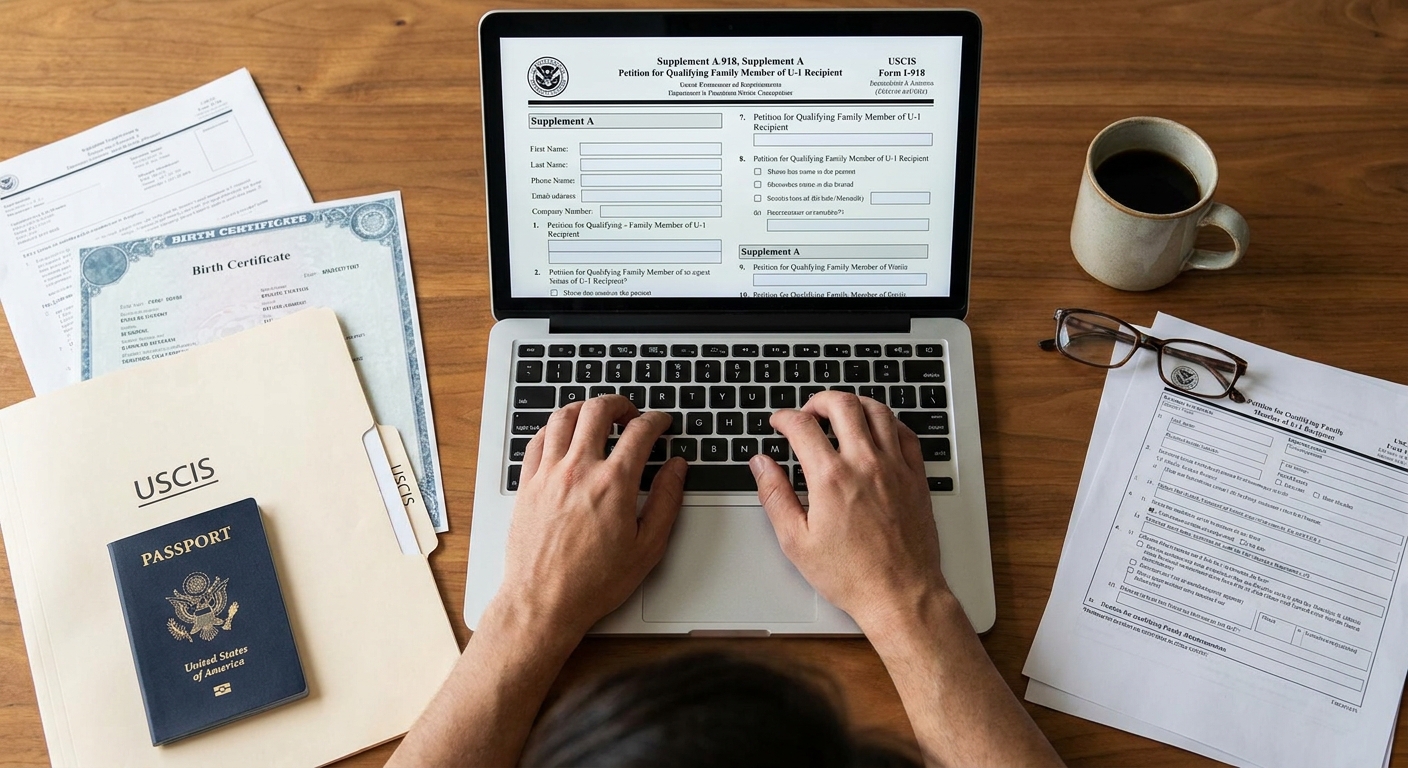
The primary form for requesting U visa status for your qualifying family members is Form I-918, Supplement A, ‘Petition for Qualifying Family Member of U-1 Recipient.’ This document initiates the process for their protection.
This form can be filed at the same time as the principal applicant’s Form I-918, or it can be submitted later, even after the principal’s U visa has been approved. This flexibility allows for different family circumstances during the application period.
For each derivative applicant, you must include supporting documents to prove the qualifying relationship, such as marriage certificates for a spouse or birth certificates for children. These documents help establish the link between the principal and each derivative applicant.
Additionally, each derivative beneficiary seeking work authorization must file a separate Form I-765, Application for Employment Authorization. This ensures they can legally work while their U visa petition is pending.
What happens if a child derivative turns 21 during the wait?
Given the notoriously long processing times for U visa petitions, a common concern for families involves child derivatives “aging out” by turning 21 before their U visa is granted. Fortunately, specific protections exist to address this situation, providing a measure of security for younger family members.
Understanding these protections significantly helps principal applicants who are planning their family’s immigration future. This means correctly calculating ages and understanding how USCIS views the eligibility timeline for all derivatives.
Age-out protection under CSPA
The Child Status Protection Act (CSPA) offers safeguards against aging out for a child derivative. The general rule is that a child’s age is “locked in” for U visa purposes as of the date the principal applicant’s Form I-918 was filed, provided the principal was under 21 at the time they filed.
This means that even if a child turns 21 during the years-long processing period, they may still be considered under 21 for derivative status, preserving their eligibility.
This protection is significant because final U visa approval can often take between 5 to 10 years due to the annual 10,000 U visa cap. While a bona fide determination (BFD) and work authorization may be issued within approximately 19-35 months for many cases, the wait for the final U-1 status is much longer.
Filing Form I-918, Supplement A as early as possible for child derivatives helps maximize the benefit of CSPA protections. This early filing secures their eligibility even with long processing times.
What if your family member is outside the United States?
Including a family member with derivative eligibility who lives outside the U.S. adds another layer of complexity to the application process. These family members cannot simply enter the country; they must go through consular processing to receive their U visa and be admitted legally.
This path requires careful coordination between the principal applicant in the U.S. and the family member abroad. It also involves working with U.S. consulates and embassies, which have their own specific procedures and requirements.
Consular processing for derivatives abroad
For derivative family members residing outside the United States, the process begins after USCIS approves their Form I-918, Supplement A. Once approved, the case is forwarded to the National Visa Center (NVC), which then coordinates with the appropriate U.S. embassy or consulate in the family member’s home country.
The NVC will schedule an interview, and the derivative must attend this interview to obtain their U visa and complete the process. This step is necessary for final approval.
During consular processing, derivative applicants undergo admissibility checks, similar to other immigrant visa applicants. If any issues of inadmissibility arise, such as certain criminal convictions or prior immigration violations, the derivative may need to file for a waiver of inadmissibility using Form I-192, Application for Advance Permission to Enter as Nonimmigrant.
Our legal counsel for consular processing can assist in preparing for this complex stage, helping to navigate potential challenges.
If a derivative family member is already in the U.S. and at risk of detention, knowing what to do if ICE detains you matters because U visa applicants and derivatives may still face enforcement encounters before adjudication.
What risks should you know about when applying for U visa family members?
While the U visa offers substantial protections, applying for U visa family members is not without potential pitfalls. Understanding these risks in advance allows for strategic planning and can help avoid devastating outcomes for your loved ones.
The lengthy processing times inherent to the U visa program often compound these challenges, making careful attention to detail and ongoing case management necessary. It is not uncommon for family circumstances to change during the years a petition is pending.
Many denials of derivative petitions trace back to issues with the principal applicant’s case or to inadmissibility grounds tied to the family member. Understanding why a U visa can be denied helps anticipate those problems and address them before they affect your loved ones.
Key challenges for U visa derivatives
- Inadmissibility: Like principal applicants, derivative beneficiaries must be admissible to the United States. If a family member has prior immigration violations, criminal history, or other grounds of inadmissibility, they may require a waiver (Form I-192) to overcome these issues.
- Principal’s petition denial: The derivative’s eligibility is tied directly to the principal applicant’s U visa approval. If the principal’s petition is denied for any reason, the derivative’s application will also be denied.
- Principal adjusting status prematurely: A significant risk occurs if the principal U-1 visa holder adjusts to lawful permanent resident (Green Card) status before their derivative family members are approved or enter the U.S. with U visa status. In such cases, the derivatives may lose their eligibility for a U visa.
The entire U visa process is lengthy. While bona fide determination and work authorization can take 19-35 months, final U visa approval is subject to an annual cap and can take 5-10 years. This extended timeline requires continuous awareness and proactive management of all applications.
Detention timelines are another concern for family members without status. How long an immigrant can be detained covers the federal limits and the legal options that apply if a derivative gets caught in ICE custody while the U visa is pending.
Can U visa family members get a green card?
For many immigrant families, obtaining a Green Card represents the ultimate goal of stability and security in the United States. Fortunately, qualifying family members do have a pathway to adjust their status to lawful permanent resident.
This process is a testament to the U visa’s purpose, which extends beyond temporary protection to offer a more permanent solution for crime victims and their immediate families. It requires meeting specific conditions and following established procedures.
Pathway to permanent residency for derivatives
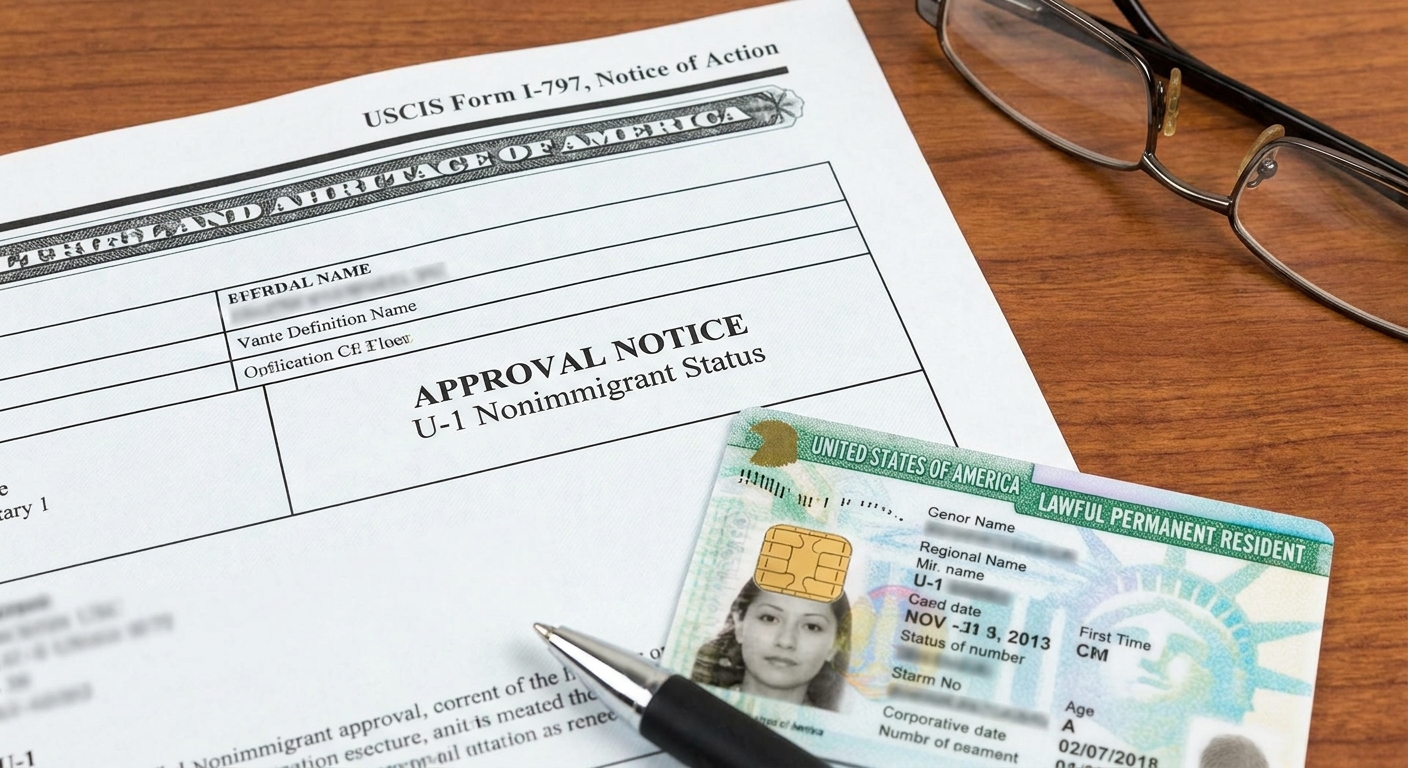
After maintaining U nonimmigrant status for three continuous years in the United States, a qualifying family member may be eligible to apply for adjustment of status to become a lawful permanent resident. This eligibility hinges on a continued demonstration of cooperation with law enforcement, if applicable.
They must also prove that their presence in the U.S. is justified on humanitarian grounds, family unity, or public interest to qualify for this status.
To apply, derivative beneficiaries must file Form I-485, Application to Register Permanent Residence or Adjust Status. This form allows them to adjust their status to become a lawful permanent resident.
In some cases, if the principal U visa holder has already adjusted status to a Green Card, qualifying family members who never held derivative U nonimmigrant status may still be eligible to apply for a Green Card by filing Form I-929, Petition for Qualifying Family Member of a U-1 Nonimmigrant.
The three-year clock for Green Card eligibility begins from the date U-1 status is granted, not from the initial filing date or the bona fide determination. Our adjustment of status attorneys and our team specializing in family-based immigration frequently help families through this next phase.
Securing protection for your family with a U visa derivative petition involves complex laws and precise timing. Navigating these detailed requirements can be daunting. As immigrants helping immigrants, Zava Immigration Law Group understands the hope and anxiety involved. When you are ready to discuss your unique family situation, our Phoenix, AZ-based team provides dedicated guidance towards a secure future.
Frequently asked questions about U visa family members
Can my family members apply for a work permit while their U visa is processing?
Yes, qualifying U visa family members can generally apply for work authorization. After filing Form I-918, Supplement A for them, they can submit Form I-765, Application for Employment Authorization. This typically allows them to obtain a work permit (EAD) while USCIS processes their U visa petition, providing crucial stability. While a bona fide determination and work authorization can take 19-35 months for many cases, securing an EAD early enables family members to work legally and support themselves.
What happens if a child listed on my U visa gets married before approval?
If a child derivative gets married before their U visa is approved, they typically lose eligibility. U visa law specifies that children must be unmarried to qualify as derivatives, regardless of the principal applicant’s age. This marital status requirement applies throughout the entire application process until the U visa is granted. Such a change in marital status generally results in the denial of their derivative petition, preventing them from obtaining U visa status through the principal.
Do my family members need to be in the U.S. to be included in my U visa?
No, your qualifying family members do not need to be physically present in the U.S. to be included in your U visa petition. If they reside outside the United States, they will generally undergo consular processing once their Form I-918, Supplement A is approved. This involves interviews at a U.S. embassy or consulate in their home country to receive their U visa and be admitted legally. Our team regularly assists families with this complex international coordination.
If I get my Green Card, can my family still get their U visas or Green Cards?
It depends significantly on the timing. If you, the principal U-1 visa holder, adjust to a Green Card before your derivative family members are approved for their U visas or enter the U.S. in U visa status, they may lose their eligibility for a U visa. However, qualifying family members who never held derivative U nonimmigrant status might still be eligible to apply for a Green Card by filing Form I-929, Petition for Qualifying Family Member of a U-1 Nonimmigrant, after your adjustment.
What kind of evidence do I need to prove my family relationships for a U visa?
To prove qualifying family relationships for U visa derivatives, you typically need official documents. For a spouse, a marriage certificate is usually required. For children, birth certificates listing both parents are standard. For parents, your birth certificate showing your parentage is necessary. And for siblings, both your birth certificate and theirs, demonstrating common parentage, are generally needed. Consistent documentation helps establish the required family link for USCIS review.
Do U visa derivative applicants also need to cooperate with law enforcement?
No, unlike the principal U visa applicant, derivative beneficiaries are generally exempt from the requirement to directly cooperate with law enforcement. Their eligibility for U visa status flows from the principal applicant’s approved petition and their qualifying family relationship. This distinction simplifies the path to protection for family members, as they do not need to meet the primary U visa eligibility requirements themselves regarding having suffered substantial abuse or cooperating with criminal investigations.
Sources and official resources
- USCIS: Immigration Options for VictimsOfficial source
- USCIS Policy ManualOfficial source

Jessica Anleu (formerly Jessica Lewis) is an experienced immigration lawyer in Phoenix with a decade of immigration experience.
All PostsRelated Posts
An immigration detainer and the 48 hour hold in Maricopa County
What an immigration detainer really means for a 48 hour hold in a Maricopa County jail, and the exact steps families should take before that window closes.
Preparing for your hearing at the Florence immigration court
The Florence immigration court operates inside one facility, but a nearby complex often gets confused with it. Here is how to tell them apart.

How the judge decides if you go home at an immigration bond hearing
An immigration bond hearing decides if you can leave detention while your case continues. Here is what the judge weighs before deciding your case.
Your privacy, your choice
With your permission, Google Analytics and Microsoft Clarity help us understand site use. Google Ads and Meta measure advertising. You can decline all or choose each category. Forms work with any choice.
Checked options stay off until you save them.