
Immigration Lawyer for SIJS in Phoenix
As immigration lawyers for SIJS, we coordinate both the state court phase and the USCIS petition so that path does not close because of a process error.
Does a young person you know need immigration protection?
And often, the person searching for information is not the minor themselves but a family member, a guardian, or someone who cares about the situation. These are the scenarios we see most often.
Abandonment can be physical — a parent who left and never came back — or it can look like total disregard for the child’s wellbeing. If a child or teenager is in the United States without the support of one or both parents, and that absence left them in a vulnerable position, SIJS may be the path to legal stability.
This is not limited to physical violence. Emotional abuse, constant intimidation, exploitation, and extreme control all count. If a minor was mistreated by one or both parents and a court determines that reunification is not viable, SIJS opens the door to an immigration status that protects them.
Many minors are already in a safe environment — with an uncle, a grandparent, a foster parent — but have no immigration status. If the reason they are not with their parents is abuse, abandonment, or neglect, SIJS can resolve that situation and give them a permanent legal path.
Some minors have already gone through state court and have an active custody or dependency order. What many do not know is that this order can be the foundation for the second phase: the immigration petition to USCIS. If the judge’s order already exists, you may be closer than you think.
SIJS is for unmarried individuals under 21. Many people assume that turning 18 disqualifies them — that is not true. If you meet the requirements and file the petition before turning 21, you qualify. The key is to act before that deadline because once you turn 21 without having filed, you lose eligibility.
How the SIJS process works and why it requires legal coordination
An immigration lawyer for SIJS must know how to navigate both for the case to move forward without interruption.
Before immigration becomes part of the picture, a state judge must issue an order establishing three things. First, that the minor was declared dependent on the court, or that their custody was assigned to a state agency or an individual. Second, that reunification with one or both parents is not viable due to abuse, abandonment, or neglect. Third, that it is not in the minor’s best interest to return to their country of origin.
This phase is family law, not immigration. But without this order, the immigration petition cannot be filed. That is why it is critical that whoever handles the case understands what the state judge needs to issue the order and how to connect it to what USCIS will require next.
With the state court order in hand, the next step is filing Form I-360 (Petition for Special Immigrant) with USCIS. There is no filing fee for this form. Once USCIS approves the petition, the minor receives the Special Immigrant Juvenile classification.
From there, the next step is to apply for adjustment of status (Form I-485) to obtain a green card. If there is any inadmissibility issue in the minor’s history, a waiver (Form I-192) can be requested as part of the process, similar to what is done with an immigration waiver.
You do not have to be the minor to take the first step
If you are concerned about a young person’s situation, you can be the one to connect them with an immigration lawyer for SIJS.
The minor can seek help if they are old enough and in a position to do so. But the process can also be started by a parent or relative who is not the abuser, a legal guardian appointed by the court, a foster parent who has the minor in their care, or a social worker or child protective services agency familiar with the situation.
What matters is that someone takes the step. Many minors who qualify for SIJS never access it simply because no one around them knew this option existed.
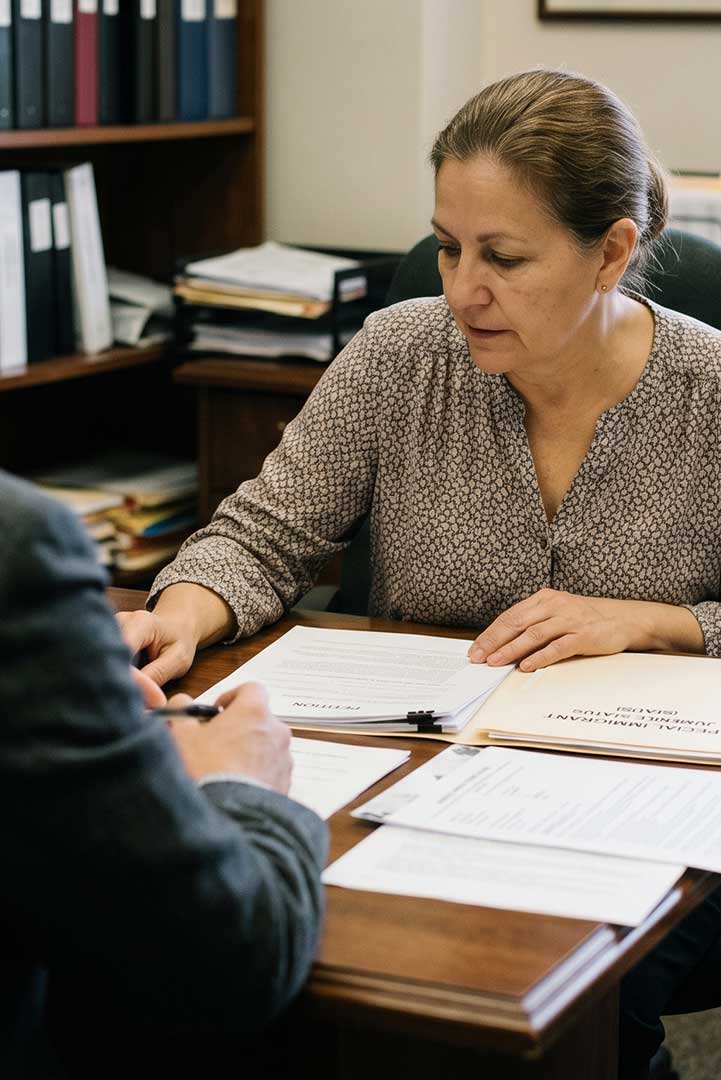
How we handle a SIJS case at our firm
A juvenile visa case requires coordination across two legal systems and careful handling of situations that involve vulnerable minors. Here is how we approach it.

We evaluate the minor's situation and determine eligibility
The first step is understanding the minor’s story: what happened with their parents, where they currently live, how old they are, whether there is a prior state court order, and whether any factor could complicate the case. With that information we determine whether SIJS is the right route or whether a different path — such as asylum or a U visa if the minor was the victim of a crime — may be more appropriate.

We coordinate the state phase
If there is no state court order yet, we work to obtain one. We build the case before the family court judge with the evidence needed to issue the custody, dependency, or guardianship order that SIJS requires. If the order already exists, we review it to confirm it meets what USCIS needs to accept the petition.

We prepare and file the I-360 petition with USCIS
With the complete state court order, we assemble the petition with all supporting documentation and file it with USCIS. The I-360 filing has no cost for the petitioner. We make sure the package is complete to avoid requests for additional evidence that delay the process.

We accompany the case through adjustment of status
Once SIJS is approved, the next step is the green card. We file Form I-485 and guide the minor through the entire adjustment of status process until they have permanent residence in hand.
What you need to know about timing, age, and the green card
The minor must be under 21 and unmarried at the time the I-360 petition is filed. If they turn 21 or get married during the process, they lose eligibility. This is the most common reason a viable case closes: waiting too long. If the minor is 17, 18, or 19, the time to act is now.
USCIS generally decides on I-360 petitions within 180 days of filing. However, the green card may take longer depending on immigrant visa availability and system backlogs. While waiting, the minor can apply for employment authorization.
One important limitation to understand: once the minor obtains SIJS and eventually permanent residence or citizenship, they will not be able to petition for their parents to receive immigration status. The law treats the SIJS beneficiary as if the parents cannot be their sponsors — even if only one parent was the abuser. This consequence is permanent and must be part of the conversation before deciding to apply.
SIJS is different from asylum in one key way: it does not require proving fear of persecution by a government or group. It is specifically for situations of family abuse, abandonment, or neglect. If the minor’s situation involves persecution based on political opinion, race, or religion, asylum may be the more appropriate route.
Immigration Lawyer for SIJS in Phoenix, Arizona
Our team has experience coordinating the state phase with the federal petition, working with family courts, and filing cases with USCIS.
If you are in Phoenix, the Valley, or anywhere in Arizona and need an immigration lawyer for SIJS who speaks your language, we are here.
Office in Phoenix, Arizona
Monday to Friday: 8:30 AM to 5:30 PM
After office hours
Every day matters when a minor is at risk
Frequently Asked Questions About SIJS
How long does SIJS take after being approved?
After USCIS approves the I-360 petition, the next step is adjustment of status to obtain the green card. Timelines depend on immigrant visa availability. In some cases it moves quickly; in others, there are waits due to system backlogs. Your attorney can give you an estimate based on the category and priority date of your case.
Can I travel outside the U.S. with SIJS?
Not while the process is pending. If you only have SIJS classification without an approved green card, leaving the United States can jeopardize your case. Once you obtain permanent residence, you can travel with your green card. Always consult your attorney before making travel plans.
What if the minor is already 18?
They may still qualify. SIJS is for unmarried individuals under 21. Being 18, 19, or 20 does not disqualify you, but time is a critical factor — if you turn 21 before USCIS receives your petition, you lose eligibility.
Can undocumented minors apply for SIJS?
Yes. You do not need legal status in the United States to apply for SIJS. If the minor meets the eligibility requirements — abuse, abandonment, or neglect by one or both parents, a state court order, and under 21 and unmarried — they can apply regardless of their current immigration status.
Do I need a lawyer to apply for SIJS?
It is not legally required, but the process involves two different legal systems — state court and USCIS — with requirements that must be precisely aligned. An error in the state court order can cause USCIS to deny the petition. An immigration lawyer for SIJS with experience in both jurisdictions significantly reduces that risk.
What happens if the SIJS petition is denied?
If USCIS denies the I-360 petition, you can file a motion to reconsider or reopen with additional evidence. You can also assess whether the issue is in the state court order and work to obtain a corrected or new one. An immigration lawyer for SIJS can analyze the reasons for the denial and determine the next steps.
Can the minor work while waiting?
Once USCIS approves the I-360 petition, the minor can apply for employment authorization (Form I-765). If they are under 18, state labor laws apply and they may need an additional work permit depending on the state where they reside.
Can the minor's parents also get immigration status?
No. This is one of the most significant limitations of SIJS. The beneficiary cannot petition for their parents to receive immigration status — not even after obtaining permanent residence or citizenship. The law treats the beneficiary as if there is no sponsorship relationship with the parents.
What is the difference between SIJS and asylum for minors?
The key difference is the cause. SIJS is for minors who experienced abuse, abandonment, or neglect by their parents. Asylum is for people who face persecution based on race, religion, nationality, political opinion, or membership in a particular social group. If the minor’s situation involves both, an attorney can evaluate which route is stronger or whether both can be pursued in parallel.
How much does an immigration lawyer for SIJS cost?
Fees vary depending on the complexity of the case and whether the state phase still needs to be resolved. What you should know is that filing Form I-360 with USCIS has no filing fee. At the initial consultation we provide a clear estimate based on the minor’s specific situation.
Contact us today
We are here to help you with all your immigration needs. Contact us today to schedule a consultation with one of our experienced attorneys. We will listen to your unique situation and provide you with personalized advice and guidance.