
U visa lawyer in Phoenix to protect your safety and your immigration future
As u visa lawyers, we make sure that right becomes a reality.
Situations where a U visa can protect you
The abuser may be your partner, your spouse or someone in your own family. Many victims do not report because they depend financially on that person or because they believe their immigration status leaves them with no options. The U visa was created to protect you in this situation. If the abuser is also your spouse and your status depends on that relationship, you may also qualify for VAWA, which does not require your partner’s cooperation.
You do not have to be a domestic violence victim to qualify. The U visa covers a broad list of crimes, from assaults and violent robberies to extortion, kidnapping and human trafficking. What matters is that you suffered physical or mental harm as a result of the crime and that you are willing to cooperate with law enforcement.
You did the right thing: you reported the crime, gave your statement, helped with the investigation. But no one explained that your cooperation could open a legal path for you. If the police or prosecutor have a record of your participation, you already have a foundation for requesting the certification the U visa requires. A u visa lawyer can evaluate where you stand and what steps remain.
This is one of the most common fears and also one of the most dangerous myths. You can apply for a U visa regardless of your immigration status. You do not need a visa, a permit or any other document. If there is a ground of inadmissibility in your history, a waiver (Form I-192) can be requested as part of the same process. The purpose of the U visa is for victims to cooperate without fear, and that includes people without status.
If someone forced you to work without pay, held you against your will or exploited you sexually, the U visa is one of the legal tools available for your protection. These cases often involve individuals in situations of extreme vulnerability and the law recognizes that reality.
What crimes qualify for a U visa
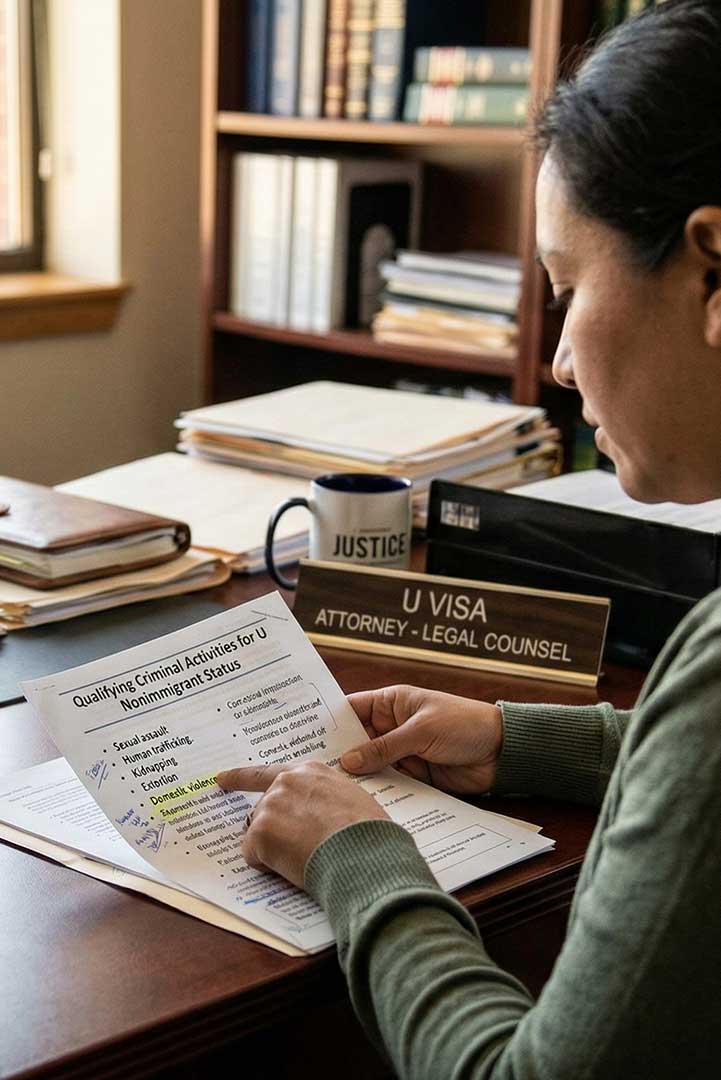
Not all crimes are covered, but the list is broader than most people think. These are the recognized offenses:
If what you experienced does not appear under the exact same name but is substantially similar to one of these offenses, you may still qualify. Attempts and conspiracies to commit any of these crimes are also included. If you are not sure, the best step is to have a u visa lawyer review your case.
How we determine if your case qualifies for a U visa
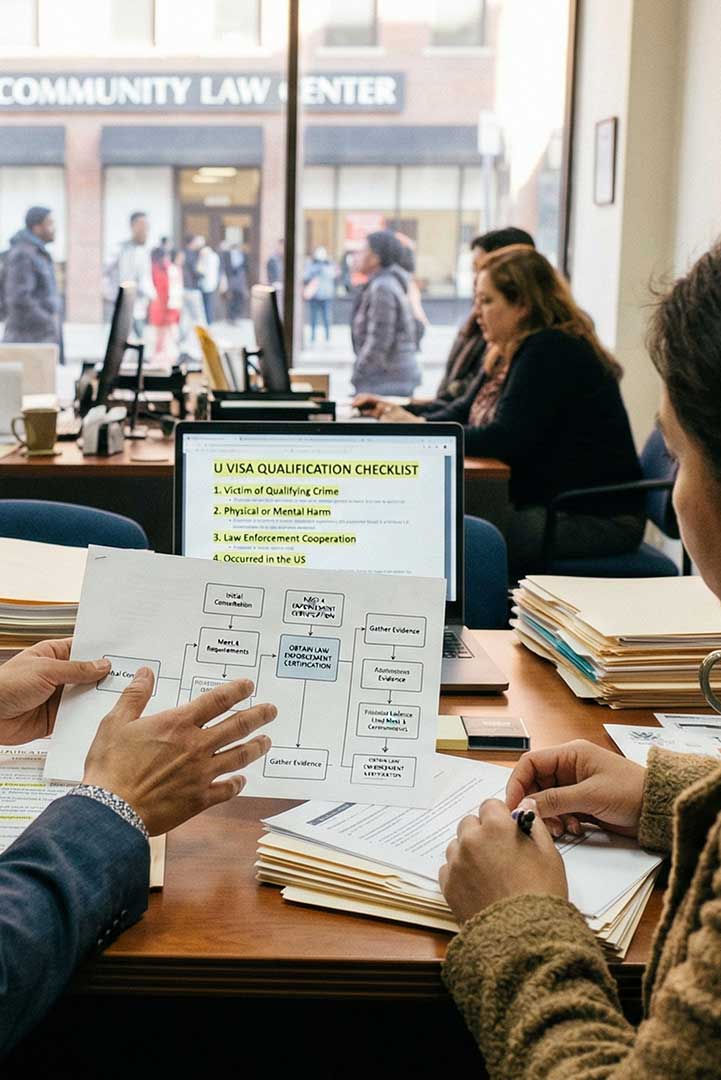
First, that you were the victim of a crime on the qualifying list or one that is substantially similar. Second, that you suffered physical or mental harm as a result of that crime. Third, that you have information about the criminal activity and have cooperated, are cooperating or are willing to cooperate with law enforcement in the investigation or prosecution. Fourth, that the crime occurred in the United States or violated U.S. laws.
If you meet all four, the next step is obtaining law enforcement certification and gathering evidence to support your petition. If any requirement is not met or there are complicating factors, we tell you before moving forward.
Law enforcement certification is the step that defines your case
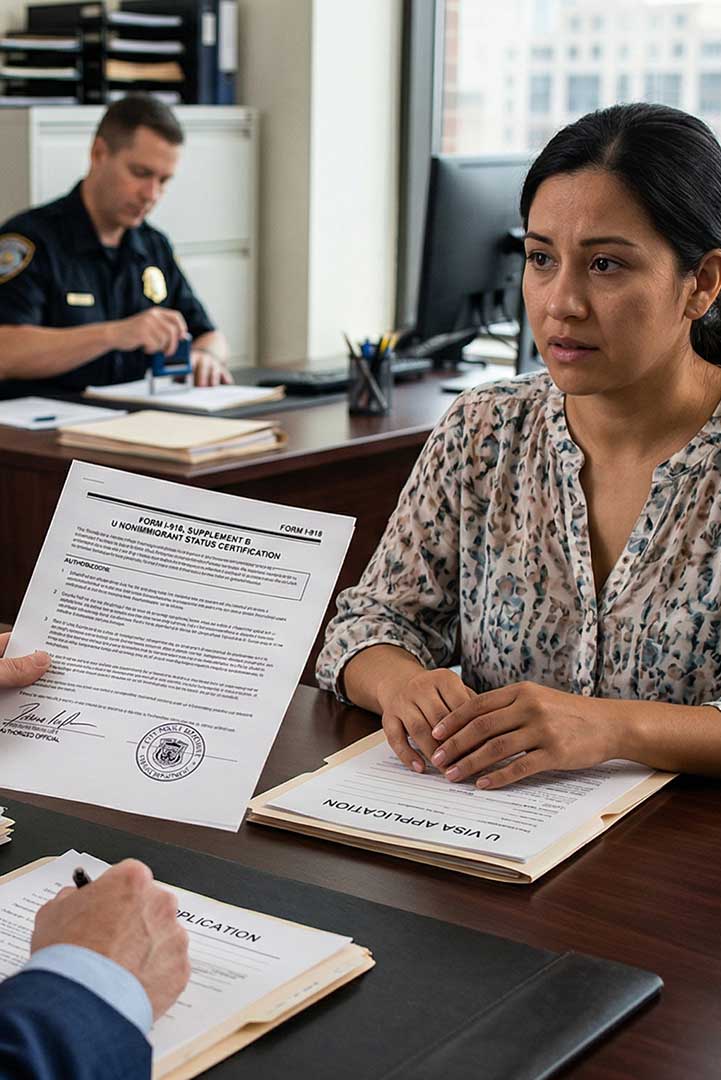
The certification is Form I-918 Supplement B. It is signed by an authorized official from a law enforcement, prosecutorial or investigative agency confirming that you were a victim of a qualifying crime and that you cooperated or are likely to cooperate with the investigation. It can be signed by police officers, prosecutors, judges, child protective services agents and other authorized officials.
What many people do not know is that law enforcement agencies are not legally required to sign this certification. They can refuse, and in practice it happens. This is one of the main reasons why working with a u visa lawyer makes a real difference.
We communicate directly with the relevant agency, explain the case, provide the necessary information and follow up until the signature is obtained. If one agency refuses, we explore alternatives with other authorized entities that had contact with your case.
How we handle your U visa case step by step
A U visa is not obtained by filling out a form. It is built with evidence, coordination with law enforcement and a petition that clearly demonstrates you meet every requirement.

We evaluate your situation and determine if you qualify
We review what crime you experienced, what contact you had with law enforcement, whether there are police or court records of the case and whether any factor could complicate the petition. If you qualify, we define the strategy. If you do not qualify for a U visa but your situation warrants protection, we evaluate alternatives such as VAWA or asylum.

We coordinate with law enforcement to obtain the certification
This is the part of the process where we add the most value as u visa attorneys. We handle contacting the relevant police or prosecutorial agency, submitting the certification request (Form I-918B) and managing the process until the signature is obtained. If the agency needs additional information or has questions about the case, we handle them directly.

We prepare and file the complete petition
With certification in hand, we gather the remaining evidence: your personal declaration describing what you experienced, medical or psychological records documenting the harm you suffered, police reports and any other documentation that strengthens your case. We file Form I-918 with USCIS along with all supporting evidence. If there is a ground of inadmissibility, we include Form I-192 to request the waiver as part of the same package.

We support you through the wait and the next steps
Once the petition is filed, we monitor the process, respond to any requests for additional evidence and keep you informed about the status of your case. If USCIS issues a bona fide determination before a visa is available, we help you obtain the work permit and deferred action that it triggers.
Your family can also be protected
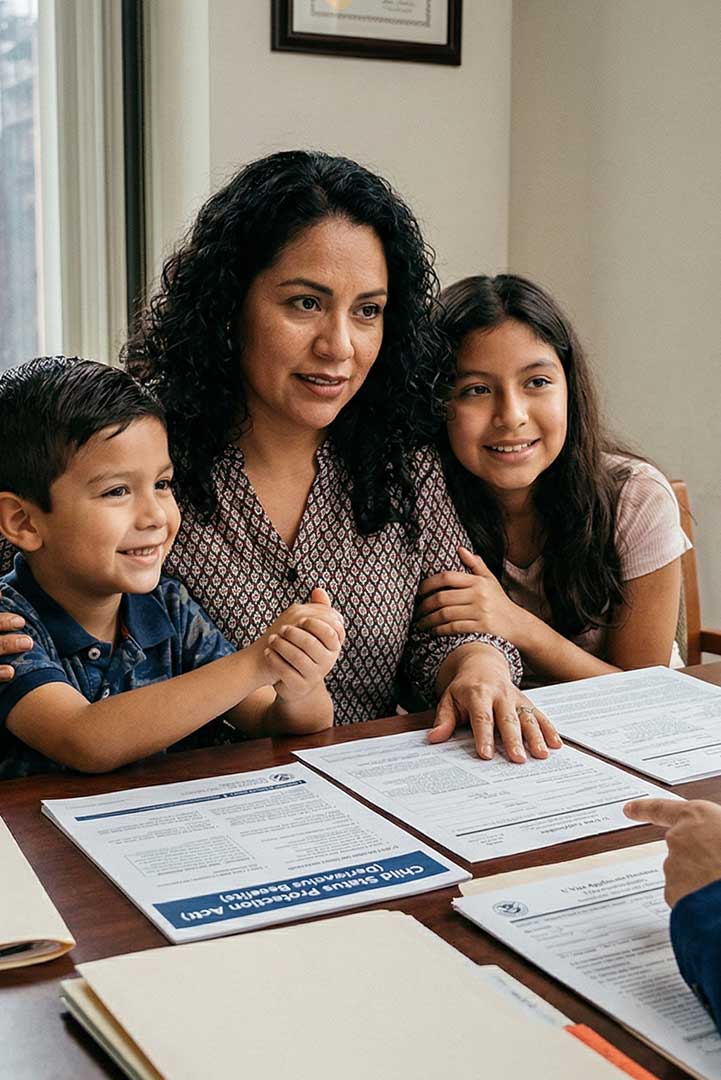
If you are 21 or older, you can include your spouse and unmarried children under 21. If you are under 21, in addition to your spouse and children you can include your parents and unmarried siblings under 18.
An important detail: if your child or sibling reaches the age limit while the case is pending, the law freezes their age at the date the petition was filed. This protection (known as age-out protection) prevents them from losing eligibility due to processing delays.
What you need to know about timelines, the wait and the cost
First, the government can only approve 10,000 U visas per year for principal petitioners. That cap creates a waitlist that currently spans several years. However, while you are on that list you are not left unprotected. If USCIS determines that your petition is bona fide, you receive deferred action and can apply for a work permit. That means you can live and work legally while you wait.
Second, filing the U visa petition has no cost with USCIS. All filing fees are waived for U visa petitioners and their derivative family members. The associated costs are the attorney fees for your legal representation.
Third, after maintaining U visa status for three continuous years, you can apply for permanent residence (green card). The U visa is not a permanent status, but it opens a direct path to one.
U visa lawyers in Phoenix, Arizona
Office in Phoenix, Arizona
Monday to Friday: 8:30 AM to 5:30 PM
After office hours
Frequently asked questions about the U visa
How much does a U visa lawyer cost?
Attorney fees vary depending on the complexity of the case. What you should know is that filing the U visa petition with USCIS is completely free. There are no filing fees for the petitioner or derivative family members. The cost is the legal representation, and during the initial consultation we provide a clear estimate based on your situation.
Can I apply for a U visa if I do not have legal status?
Yes. The U visa can be filed regardless of your immigration status. You do not need a visa, permit or any prior document. If there is a ground of inadmissibility in your history, a waiver (Form I-192) can be requested as part of the same process.
How long does the U visa process take?
The timelines are long. Due to the annual cap of 10,000 visas, the waitlist currently spans several years. But if USCIS determines that your petition is bona fide, you receive deferred action and can apply for a work permit while waiting for the visa.
Can a U visa be denied?
Yes. The most common reasons for denial are insufficient evidence of the crime or harm suffered, lack of law enforcement certification, failure to demonstrate cooperation with authorities or having grounds of inadmissibility without having requested the corresponding waiver. With proper legal representation, many of these issues are prevented before the petition is filed.
Can I travel outside the United States with a U visa?
Once your U visa status is approved, you can apply for advance parole to leave and return. However, traveling to the country where the crime occurred may raise questions about the validity of your case. Any travel should be discussed with your attorney before making a decision.
What is a bona fide determination for the U visa?
It is a review USCIS conducts on your petition before a visa is available. If it determines that your case meets the requirements (is bona fide), you receive deferred action, which protects you from deportation, and you can apply for a work permit. It is the protection you have while waiting on the list to receive the visa.
Can I get a work permit while waiting for my U visa?
Can I get a work permit while waiting for my U visa?
Yes. If USCIS issues a bona fide determination on your petition, you can apply for an Employment Authorization Document (EAD) to work legally while waiting for the visa to become available.
Can my children and spouse also get protection?
Yes. You can include your spouse and unmarried children under 21 as derivatives in your petition. If you are under 21, you can also include your parents and unmarried siblings under 18. The law protects against age-out by freezing the age of family members at the date the petition was filed.
What happens if police refuse to sign the certification?
Law enforcement agencies are not legally required to sign Form I-918B. If the agency that handled your case refuses, a u visa lawyer can contact other authorized entities (prosecutors, judges, protective services) that had contact with your case to obtain certification through an alternative path.
Does a U visa lead to permanent residence?
Yes. After maintaining U visa status for three continuous years and meeting certain requirements, you can apply for permanent residence (green card). The U visa is temporary, but it is a direct path to lawful permanent residence in the United States.
Contact us today
We are here to help you with all your immigration needs. Contact us today to schedule a consultation with one of our experienced attorneys. We will listen to your unique situation and provide you with personalized advice and guidance.