
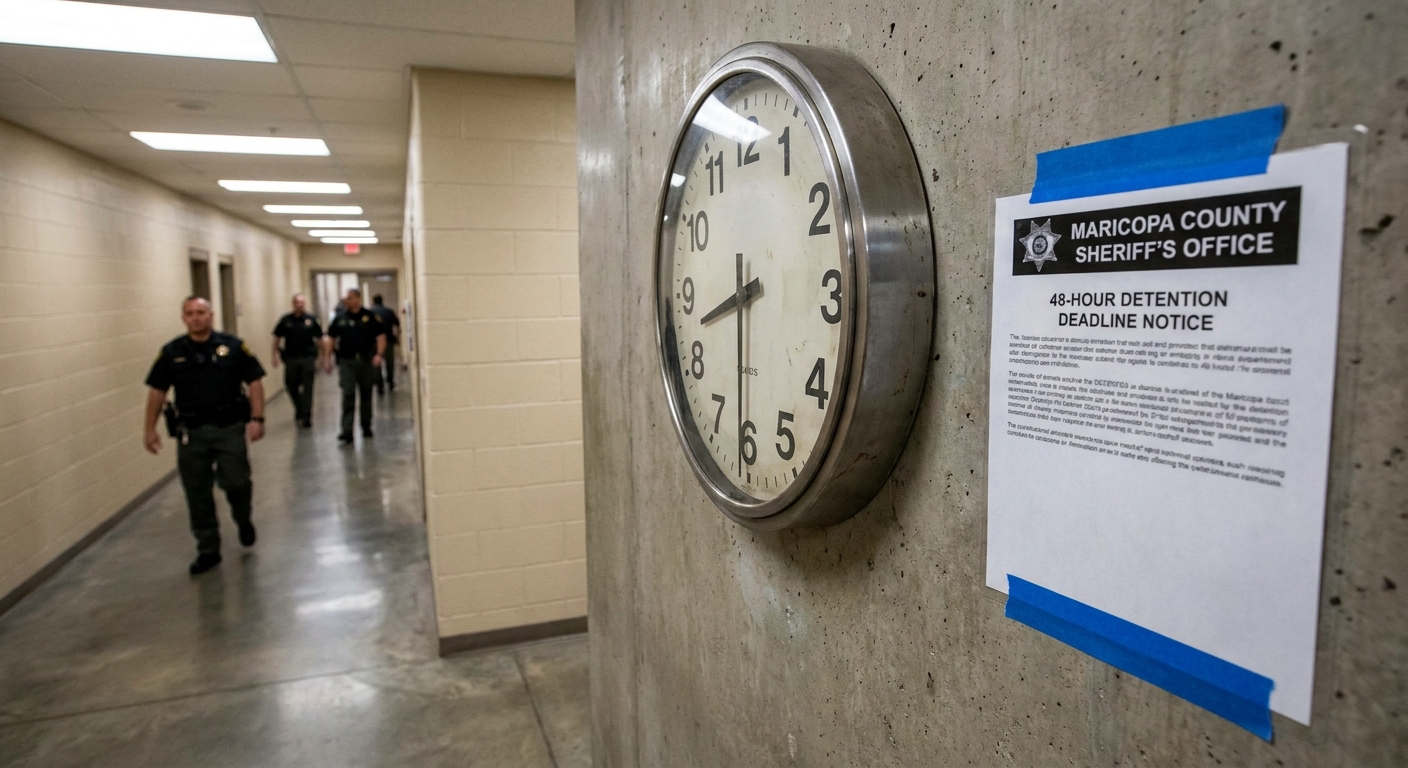
An immigration detainer and the 48 hour hold in Maricopa County
Table of contents
A Maricopa County jail cannot legally hold someone indefinitely just because a federal agency asks. Under federal law, an immigration detainer is a request for local law enforcement to keep a person in custody for up to 48 hours beyond their scheduled release.
That window exists so federal agents can arrive and take the person into custody for possible removal proceedings. It is a request, not an automatic transfer, and involving a criminal immigration lawyer early helps clarify exactly what the detainer does and does not authorize.
Every hour spent in local custody can matter for legal preparation. Working with deportation defense attorneys helps families weigh whether paying bail is a strategic move, since a bond that seems routine can sometimes speed up a transfer to ICE instead of preventing one.
Calculating the clock during an ICE hold in a county jail
If ICE has only just placed a hold on your relative, see what to do if ICE detains you for the immediate steps that we do not repeat here.
The most frequent misunderstanding about an ICE hold in a county jail is when the clock actually starts. Federal regulations specify that the 48-hour limit only begins at the moment the individual is legally cleared for release from their criminal charges.
This occurs if the person posts bail, has their charges dismissed, or completes their criminal sentence in a facility like 4th Avenue or Towers Jail.
Administrative realities in Arizona mean that the countdown on an ICE hold excludes weekends and holidays. If a judge orders a release on a Friday afternoon, the 48-hour period might not start until Monday morning.
This delay provides a necessary window to organize a defense strategy with our team, preventing your relative from being moved before a legal plan is in place.
This weekend and holiday exclusion is set by federal regulation 8 CFR 287.7(d), which governs how long a detainer may extend someone’s custody. The table below shows how that rule plays out in three common scenarios:
| Detention scenario | Calculation rule | Deadline for release |
|---|---|---|
| Release ordered Tuesday morning | Clock starts immediately | Thursday morning |
| Bail posted Friday evening | Weekends are excluded | Tuesday evening |
| Charges dropped before a holiday | Holidays do not count | 48 hours after the holiday ends |
Local law enforcement agencies must strictly adhere to these limits to avoid violating Fourth Amendment rights. Since 2017, the Maricopa County Sheriff’s Office has followed a policy of not extending someone’s custody past their ordered release time based solely on a civil ICE detainer, a practice confirmed as still in effect in 2026 under Sheriff Jerry Sheridan.
The office does coordinate with federal authorities, and two ICE officers work inside the county jails to help verify status before someone is released, but that coordination does not extend the legal 48-hour window on its own.
If the deadline passes without federal agents taking custody, the jail is legally obligated to let the person go.
Whether a local jail should honor an ICE detainer at all, separate from how long it may hold someone once it does, remains a point of ongoing legal debate in several states.
Can I pay a criminal bond if there is an immigration detainer on my case?

Paying a criminal bond while an immigration detainer is active is one of the most consequential decisions a family can make. The moment the bond is processed and the jail verifies that no other criminal holds exist, the 48-hour clock begins.
In many Arizona cases, ICE agents are already stationed near the jail or have been notified electronically, which can lead to a transfer within hours of the bond payment.
If the transfer happens before you can reach the facility, our guide on how to locate a person detained by ICE walks through the phone numbers and online tools used to search by A-number.
It is generally recommended to hire immigration bond attorneys before posting any money with the criminal court. Without a plan for what happens after the transfer, you may find your relative moved from Phoenix to a detention center in Eloy or Florence the same night.
This shift often makes it harder to maintain contact and significantly increases the complexity of the legal battle.
Rushing the criminal release without a strategy carries several immediate risks:
- Loss of funds: Money paid for a criminal bond does not carry over to an immigration bond, and depending on how the person entered the country, a bond hearing before an immigration judge might not even be available.
- Immediate transfer: Federal agents in Maricopa County are often already coordinated with jail staff, so once the criminal hold lifts, a transfer to federal custody can happen quickly.
- Lack of preparation: Moving to a federal facility without documents or a legal representative ready makes it difficult to fight for a stay of removal.
- Jurisdiction shifts: A transfer might move the case from the Phoenix immigration court to a court with a less favorable record for certain types of relief.
What happens when federal authorities fail to act within the 48 hour window?
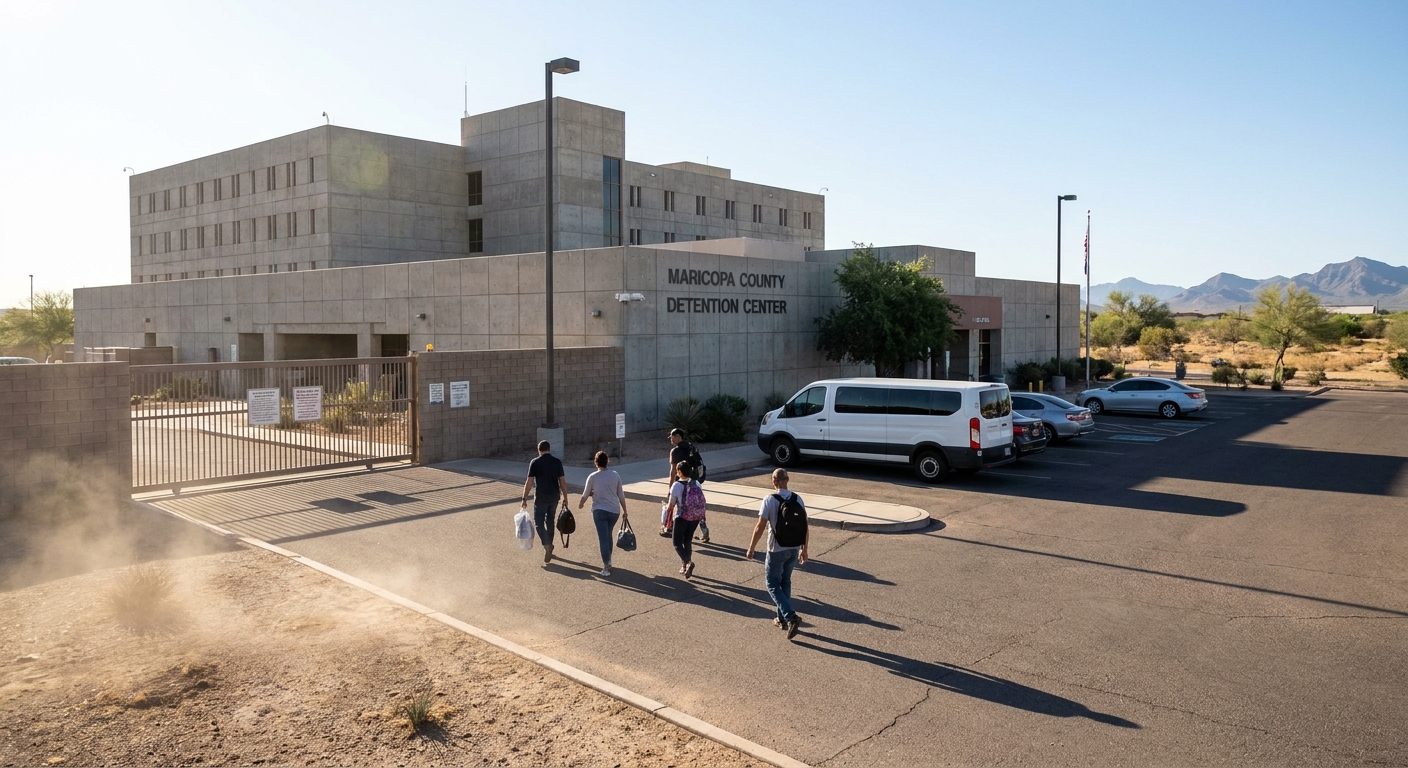
The immigration detainer is legally defined as a request, not a mandatory warrant that grants permanent custody. If federal agents do not arrive to take the individual within the 48-hour period, excluding weekends and holidays, the jail loses its legal basis for detention.
At that point, the person should be released under the same conditions as any other individual who has satisfied their criminal obligations.
Administrative errors or logistical delays sometimes prevent federal agents from completing the ICE pickup from the jail within the required timeframe. When this occurs, it is not uncommon for jails to continue holding the person out of caution or a lack of communication between departments.
In these moments, having a legal representative demand an immediate release is often the only way to prevent an extension of custody that lacks a legal basis.
If you suspect the 48-hour limit has passed, you should follow these steps:
- Verify the release order: Ensure the criminal court or jail has officially cleared the person for release.
- Confirm the start time: Note the exact hour and date when the criminal hold was lifted to track the 48-hour window.
- Document the delay: Record every conversation with jail staff regarding why the person is still being held.
- Seek immediate intervention: Contacting our team allows for a formal demand to the jail or a potential habeas corpus filing in federal court.
It is generally recommended to hire deportation defense attorneys to monitor this window closely. If the jail ignores the 48-hour expiration, they are opening themselves up to legal liability, and a swift professional response often forces the release before ICE can correct their logistical failure.
Strategic steps for handling an immigration detainer alongside criminal charges
When an immigration detainer exists, the criminal case cannot be viewed in isolation. Every plea agreement, sentence length, and conviction type carries a direct consequence for future status in the United States.
A criminal defense strategy that seems favorable because it avoids jail time might still trigger mandatory deportation if the charge is classified as an aggravated felony.
Certain crimes involving moral turpitude can also put someone’s status at risk, though whether that leads to mandatory removal generally depends on factors such as the sentence imposed, the number of convictions, and whether a petty-offense exception might apply.
Balancing the criminal plea with deportation risks

A criminal defense must be immigration-safe to protect the person from permanent removal after the 48-hour hold. This often means negotiating for specific language in a plea deal or seeking a different charge that does not carry the same immigration weight.
Resolving the criminal side is just the first step in a larger battle to keep the family together in Arizona.
While the person is in Maricopa County custody, we focus on gathering the evidence needed for the next phase of the case. This includes proof of community ties, rehabilitation efforts, and family dependencies that will be required once the case moves to an immigration judge.
Preparing these materials early ensures that when the transfer to federal custody happens, the defense is already in motion.
Preparing for the immigration bond hearing
Securing release from an immigration detainer does not automatically mean a bond hearing follows. As of September 2026, most people who entered the United States without being inspected can no longer ask an immigration judge for a bond, and Arizona is not one of the limited areas where that rule is currently paused.
Our guide on the immigration bond hearing covers how a judge decides and what evidence to bring, so we do not repeat that process here.
Rushing to pay a criminal bond without a plan for the next phase can lead to a fast transfer to Eloy or Florence before a defense is in place. At Zava Immigration Law Group, we are immigrants helping families in Arizona protect their rights before that 48-hour window closes.
Frequently asked questions about immigration detainers
Where do they take someone from Maricopa County if ICE picks them up?
If federal agents take custody after the 48-hour window, individuals in the Phoenix area are typically transported to large detention facilities in Southern Arizona, such as those located in Eloy or Florence. These centers operate under federal jurisdiction, which may change the court handling the case. Identifying the specific facility immediately allows for the coordination of legal representation before the initial appearance in front of an immigration judge.
Does the 48 hour rule apply to legal permanent residents with a green card?
An immigration detainer can be issued for anyone federal authorities believe may be subject to removal, including legal permanent residents who have certain criminal convictions. The same 48-hour limit applies regardless of current legal status. If a green card holder faces an ICE hold in a Maricopa County jail, the focus often shifts to whether the underlying criminal charge triggers mandatory detention or affects their ability to remain in the United States.
What if the jail refuses to release my relative after the 48 hours have passed?
Administrative delays or miscommunications between local jail staff and federal agencies sometimes lead to unlawful detention beyond the legal limit. If the 48-hour window expires and federal agents have not arrived, the jail no longer possesses the legal authority to keep the individual in custody. In these instances, a legal representative may need to intervene with the facility supervisors or file an emergency petition in court to secure an immediate release.
Can I visit my family member while they are under an immigration hold at 4th Avenue Jail?
Visitation rights generally follow the standard rules of the Maricopa County Sheriff’s Office as long as the person remains in local custody. However, the 48-hour period is often chaotic, and the risk of a sudden transfer to a federal facility is high. Whether a bond hearing will even be available afterward depends on how the person entered the country, so it is safer to use this time to gather proof of residency, employment records, and family ties for whichever stage of the case comes next, rather than assuming multiple visitation opportunities or a guaranteed bond hearing.
Will ICE come to our home if the jail releases my relative because the clock ran out?
While a release from jail due to an expired detainer is a significant relief, it does not mean the immigration case is closed. Federal authorities still have the person’s information and may attempt to locate them later at their residence or workplace to initiate removal proceedings. This scenario provides a specific window to consult with legal professionals and prepare a defense strategy before any further enforcement actions occur in the community.
Sources and official resources
- EOIR: Learn About Immigration CourtOfficial source
- USCIS Policy ManualOfficial source

Jessica Anleu (formerly Jessica Lewis) is an experienced immigration lawyer in Phoenix with a decade of immigration experience.
All PostsRelated Posts
Preparing for your hearing at the Florence immigration court
The Florence immigration court operates inside one facility, but a nearby complex often gets confused with it. Here is how to tell them apart.

How the judge decides if you go home at an immigration bond hearing
An immigration bond hearing decides if you can leave detention while your case continues. Here is what the judge weighs before deciding your case.
Court Blocks USCIS High Risk Country Hold
Reading time: 5 minutes The U.S. District Court for the Northern District of California has blocked the federal government’s policy that placed administrative freezes on applications from dozens of designated nations. On August 24, 2026, the court issued an injunction against the U.S. Citizenship and Immigration Services policies outlined in Policy Memorandu
Your privacy, your choice
With your permission, Google Analytics and Microsoft Clarity help us understand site use. Google Ads and Meta measure advertising. You can decline all or choose each category. Forms work with any choice.
Checked options stay off until you save them.