
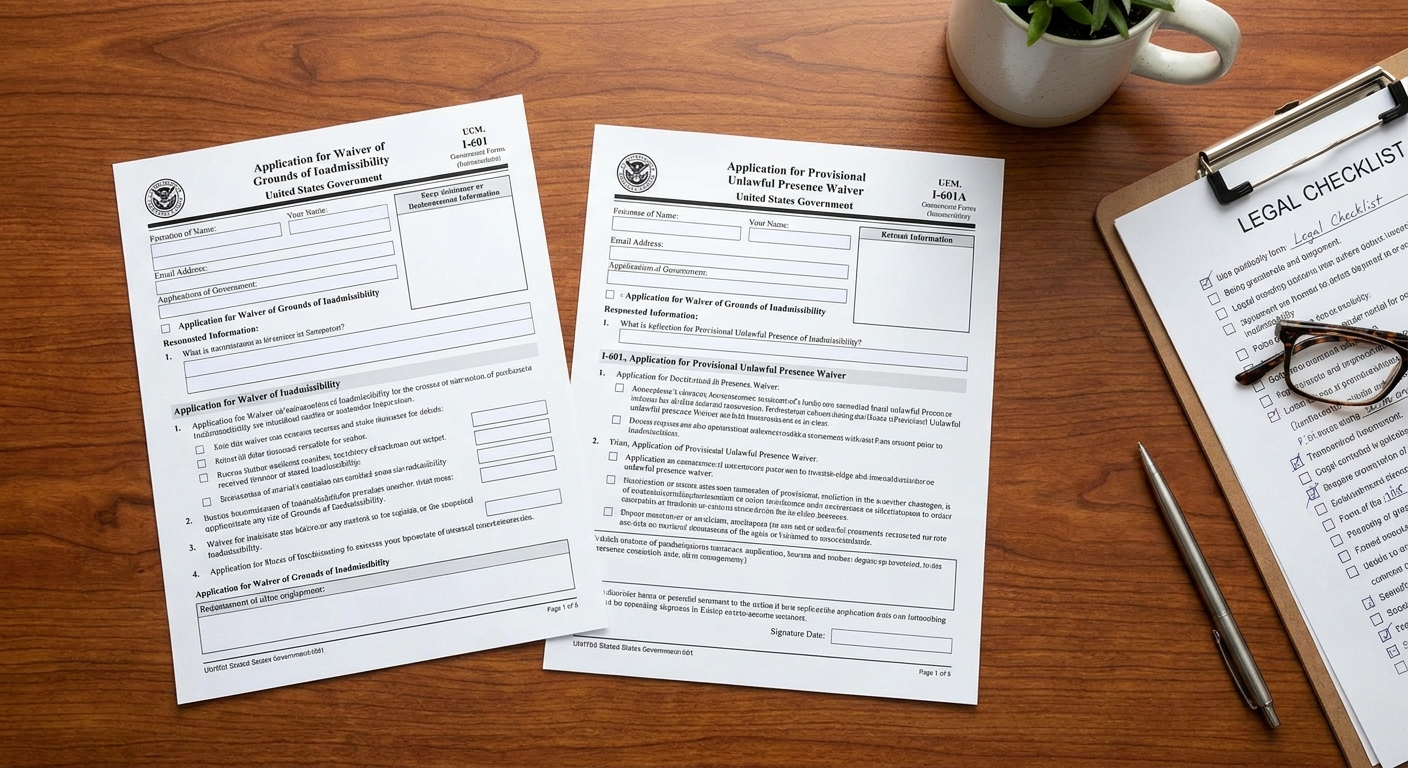
I-601 waiver or I-601A waiver, which one applies to your case?
Table of contents
8 minute read
The I-601 waiver and the I-601A waiver sound almost identical, but they solve different problems. One asks the government to forgive a specific ground of inadmissibility. The other only forgives unlawful presence, and it lets you wait for the answer at home instead of abroad.
Choosing the wrong one can leave you outside the country for years. Working with experienced immigration waiver lawyers early is what tells you which form your case actually needs, before you book a consular interview and leave American soil.
What each waiver forgives and where you file it
The standard I-601 waiver is the broad tool. It can address several grounds of inadmissibility at once, including fraud or misrepresentation, certain crimes, and some health-related grounds. It can be filed from inside or outside the United States, and in consular cases it comes after the officer formally finds you inadmissible.
The provisional I-601A waiver is narrow on purpose. It forgives one thing only: unlawful presence. You file it from inside the United States, before you travel, and you stay here while USCIS decides.
| Criterion | Standard waiver (I-601) | Provisional waiver (I-601A) |
|---|---|---|
| Filing location | Inside or outside the U.S. | Must be inside the U.S. |
| Grounds covered | Broad (fraud, certain crimes, health) | Unlawful presence only |
| Qualifying relative | Depends on the ground being waived | U.S. citizen or LPR spouse or parent |
| Consular interview | Filed after the interview | Filed before the interview |
Who counts as a qualifying relative for each waiver
This is where most people get the answer wrong, because there is no single list. The qualifying relative changes with the ground you are asking the government to forgive.
- Unlawful presence under INA 212(a)(9)(B): a U.S. citizen or lawful permanent resident spouse or parent. This is the ground the I-601A covers.
- Fraud or misrepresentation under INA 212(i): a U.S. citizen or LPR spouse or parent. Children do not count here, even U.S. citizen children.
- Certain criminal grounds under INA 212(h): a U.S. citizen or LPR spouse, parent, son, or daughter.
So a U.S. citizen child can be the qualifying relative for a criminal ground and not for a fraud ground, in the same family and the same case. That single distinction decides whether a waiver is available to you at all.
What extreme hardship means and how it is measured
Extreme hardship is not your hardship. It is the hardship your qualifying relative would suffer, and the standard sits above the ordinary pain any family feels when it is separated. Homesickness, missing a parent, or a drop in household income are expected consequences, not extreme ones on their own.
Two practical rules help more than any list of documents. You only need to prove extreme hardship to one qualifying relative, not to all of them. And when no single relative reaches the standard alone, USCIS can consider the hardship to two or more of them together to decide whether the case meets it.
Officers also weigh hardship in two scenarios: what happens if your relative moves abroad with you, and what happens if your relative stays here without you. A strong filing answers both.
What happens if you file the wrong waiver
Filing the narrow form when your case needed the broad one creates a specific trap. USCIS can approve the provisional waiver, you travel to your interview, and the consular officer then finds a ground of inadmissibility that the I-601A never covered. The approval does not protect you from that ground.
You should confirm which grounds apply to your record before you leave. Our consular processing attorneys review the full immigration and criminal history first, because that review is what determines the form, not the other way around.
- Loss of protection: a provisional approval can be revoked if a new ground appears at the consulate.
- Non-refundable costs: filing fees and preparation costs are not returned if the form type was wrong.
- Added delay: starting a new waiver from abroad can add a long wait, often measured in years rather than months.
- Legal exposure: leaving without the right waiver can trigger the very bar you were trying to avoid.

Why the I-601A lets you wait for your answer inside the United States
The provisional waiver exists to shorten family separation. Instead of leaving first and hoping for forgiveness later, you get the decision while you are still here.
Keeping the household stable while USCIS decides
Waiting at home means you keep working, keep supporting your dependents, and keep your children in the same schools. Processing times for this form are long and they move: they differ by service center and change from month to month, so check the current figure on the USCIS processing times page rather than relying on a number you read once.
Staying here also makes a Request for Evidence far easier to answer. You can gather updated medical or financial records locally, without the delays of international mail, and respond within the deadline.
What the I-601A requires
- Age: you must be at least 17 years old at the time of filing.
- An immigrant visa case: since the 2016 expansion, the provisional waiver is open to anyone statutorily eligible for an immigrant visa, not only to approved I-130 family petitions.
- Fees paid: the immigrant visa processing fee must be paid to the National Visa Center.
- Physical presence: you must be physically present in the United States when you file and when you give biometrics.
- Unlawful presence only: the waiver covers that ground alone, so any other ground has to be handled separately.
When the standard I-601 waiver becomes your only option
Some grounds simply fall outside what the provisional form can reach. When your record includes anything beyond unlawful presence, the I-601 waiver is not the alternative you choose: it is the only one available to you.
Inadmissibility for fraud or misrepresentation
Cases built on fraud or a material misrepresentation, such as using a false passport or lying on an earlier visa application, fall outside the provisional route. If you are adjusting status inside the country, our adjustment of status attorneys can confirm whether the I-601 can be filed directly with USCIS.
These waivers are demanding. You have to show extreme hardship to a qualifying spouse or parent, and separation by itself rarely meets the standard. Note that time accrued in the country without status is a different ground with its own rules, and many cases carry both.
Criminal grounds
Criminal inadmissibility is its own analysis, and it deserves more space than a waiver comparison allows. What matters here is the practical point: a criminal ground is not automatically fatal to the provisional route, but it has to be examined before you file. We cover how the grounds and the waivers interact in our guide on green cards and criminal records.
A record is also not a single fact, and two people with what sounds like the same history can end up on opposite sides of the eligibility line. This is the point where a case review by family-based immigration attorneys changes the strategy, not the paperwork.
What documents prove extreme hardship
Evidence carries the I-601 waiver, whichever ground you are asking the government to forgive. The goal is not volume: it is showing, with specific records, what changes in your relative’s life if the case is denied.
Medical and psychological impact
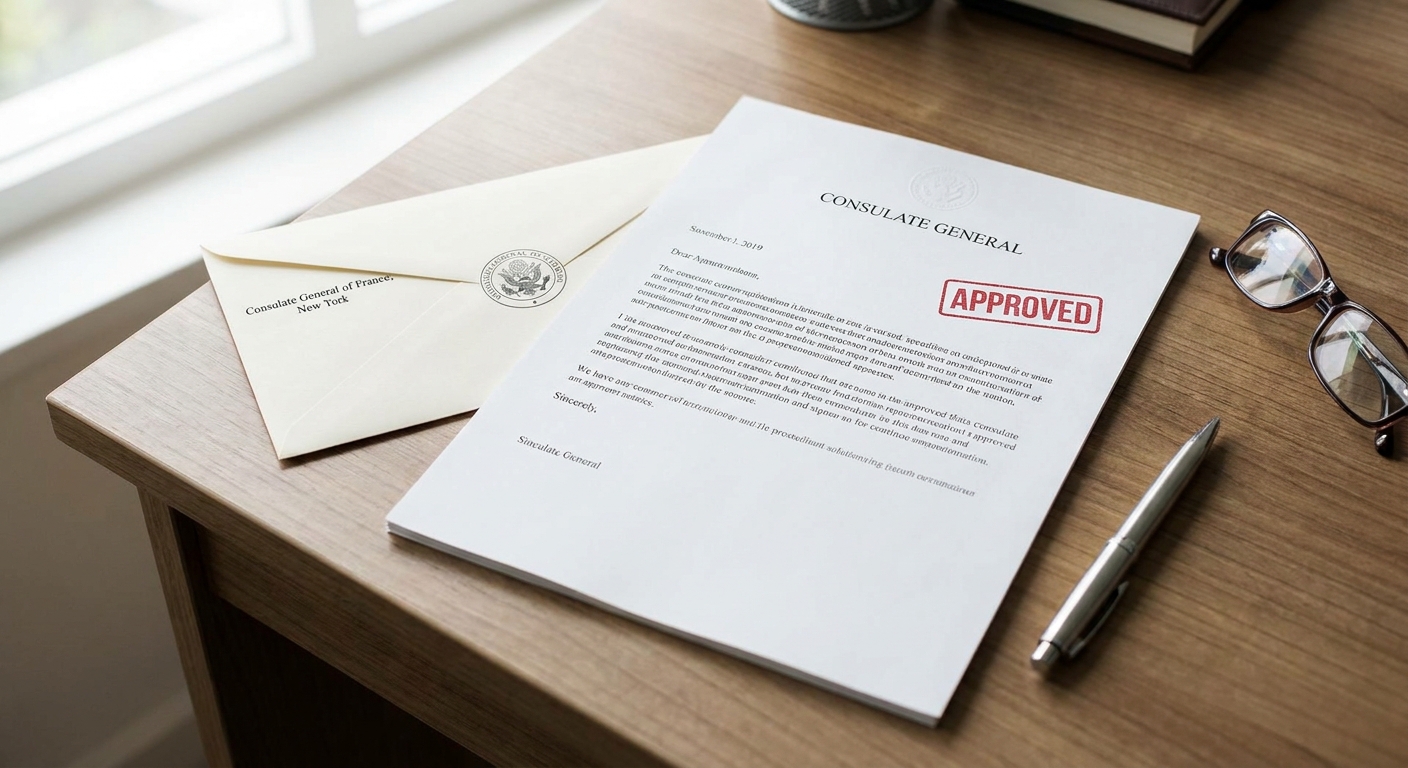
Medical records showing a qualifying relative’s chronic illness are among the strongest evidence available, especially when treatment would not be accessible in your home country. The point is not the diagnosis alone but what your absence changes about their care.
Psychological evaluations from licensed professionals document conditions such as clinical depression or severe anxiety and how separation would worsen them. Paired with country condition reports explaining why your relative cannot relocate, this evidence turns a general claim into a specific one.
Financial and educational ties
Financial records show what your absence would actually cost the household. This includes proof that your income covers mortgage payments, medical bills, or tuition, and evidence that your relative could not cover them alone.
- Mortgage and debt statements: proof the household cannot be sustained on one income.
- Employment records: documentation of your relative’s inability to find work in your home country.
- School records: evidence of your children’s integration into the American education system.
- Country condition reports: expert material on the lack of medical or educational resources abroad.
What happens if USCIS denies your waiver
A denial does not produce a removal order and it does not send officers to your home. You generally stay in the same immigration situation you were in before you filed.
What changes is the procedure, and this is where the two forms differ sharply. There is no appeal and no motion to reopen or reconsider for a denied I-601A. What you can do is file a new I-601A, with the problem that caused the denial fixed, as long as you still meet the requirements.
The other route stays open too. If you proceed with the consular interview and the officer finds you inadmissible, you can then file the standard I-601 from abroad. It is the slower path, and it means being outside the country while it is decided, which is exactly what the provisional waiver was designed to avoid.
What risks remain after your I-601 waiver is approved
An approved I-601 waiver removes one hurdle. It is not a visa and not a green card, and the consular officer keeps the authority to deny the case on other grounds found at the final interview.
If the consulate identifies a ground your filing never covered, the approval does not reach it. This is why the record review at the start matters more than the paperwork at the end.
- New criminal findings: an arrest after approval can change the analysis.
- Prior removal orders: undisclosed orders often surface during the final background check, and a prior removal also calls for the I-212 waiver, which asks for consent to reapply for admission.
- Public charge: the consulate can still deny a visa on this basis.
- Medical grounds: conditions found at the medical exam can create a new barrier.
Choosing between these two waivers is a decision about your record, not about paperwork, and it is much harder to fix once you have already left the country.
At Zava Immigration Law Group we are immigrants helping immigrants, and we read the full history before recommending a form. Contact our team in Phoenix, AZ to have your case reviewed before you take the next step.
Frequently asked questions about I-601 waivers
Can my U.S. citizen children count as qualifying relatives for the I-601A waiver?
No. For the I-601A provisional waiver, the qualifying relative must be a U.S. citizen or lawful permanent resident spouse or parent. Children do not qualify, even U.S. citizen children. They can qualify for a different waiver: under INA 212(h), which covers certain criminal grounds, a U.S. citizen or LPR son or daughter does count. What decides it is the ground being waived, not where you file. That is why two families with similar histories can get opposite answers.
Does an arrest that resulted in dismissed charges prevent me from filing the provisional waiver?
Not automatically. USCIS removed the old “reason to believe” standard in 2016, so the agency can no longer deny an I-601A simply because it suspects another ground of inadmissibility might apply. A dismissal, a diversion program, or an offense that falls within the petty offense exception may leave you with no criminal ground at all. The record still has to be reviewed carefully before filing, because if a criminal ground does apply, the I-601A cannot waive it.
What can I do if my I-601A waiver is denied?
A denied I-601A cannot be appealed, and there is no motion to reopen or reconsider available for it. You have two realistic options. You can file a new I-601A once the reason for the denial has been addressed, provided you still meet the requirements. Or you can continue with consular processing and file the standard I-601 from abroad after the officer formally finds you inadmissible. A denial by itself does not create a removal order.
Can I apply for a work permit while my I-601 or I-601A waiver is pending?
No. Filing a waiver on its own does not grant work authorization or legal status while you wait. These forms forgive specific grounds of inadmissibility; they are not applications for a benefit that carries employment authorization. You can only work legally if you have a separate application pending that provides it, such as an adjustment of status. Most people waiting on a provisional waiver remain in the same situation they were in before filing.
What should I do if I already left the United States and then realized I needed a waiver?
Once you have departed, the provisional I-601A is no longer available to you: it requires physical presence in the United States. Your route is the standard I-601 from your home country. In practice that means attending the consular interview first, where the officer formally finds you inadmissible, and filing the waiver after that. It usually means a longer separation, which is the specific outcome the provisional waiver was created to prevent.
Sources and official resources
- USCIS Policy ManualOfficial source

Jessica Anleu (formerly Jessica Lewis) is an experienced immigration lawyer in Phoenix with a decade of immigration experience.
All PostsRelated Posts

An immigration detainer and the 48 hour hold in Maricopa County
What an immigration detainer really means for a 48 hour hold in a Maricopa County jail, and the exact steps families should take before that window closes.

Preparing for your hearing at the Florence immigration court
The Florence immigration court operates inside one facility, but a nearby complex often gets confused with it. Here is how to tell them apart.

How the judge decides if you go home at an immigration bond hearing
An immigration bond hearing decides if you can leave detention while your case continues. Here is what the judge weighs before deciding your case.
Your privacy, your choice
With your permission, Google Analytics and Microsoft Clarity help us understand site use. Google Ads and Meta measure advertising. You can decline all or choose each category. Forms work with any choice.
Checked options stay off until you save them.